
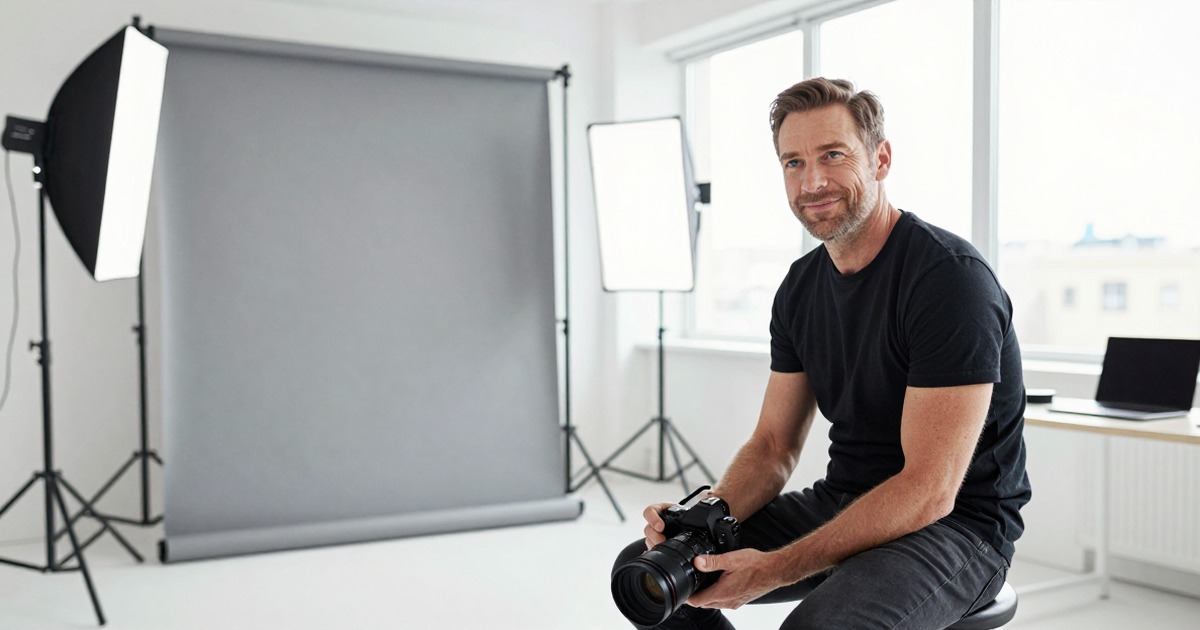
The conversation around AI and photography has been predictably binary. Either AI is going to destroy photography or it's a gimmick that real photographers don't need to worry about. Both positions are wrong, and the photographers who figured that out early are making money from both.
This article isn't about whether AI headshots are "good enough." That debate is settled. It's about what smart photographers are doing with AI headshot technology right now to expand their businesses rather than lose them.
The Market Reality
The AI headshot market is growing fast. Millions of people are paying $20 to $50 for AI-generated professional photos instead of $200 to $500 for a studio session. That's not going to reverse.
But here's the part that gets lost in the panic: most of those people were never going to book a photographer. They were going to use a bad selfie, an old photo, or nothing at all. AI headshot platforms didn't steal these customers from photographers. They created a market segment that previously didn't exist, people who want professional-looking photos but were never willing to pay photographer prices or spend photographer time.
The photographers losing business to AI are the ones whose entire value proposition was "I have a camera and a studio." If a $27 AI platform can match that value proposition, it wasn't a strong value proposition to begin with.
The photographers thriving alongside AI? They offer something AI cannot replicate. They're using AI to handle the work they didn't want anyway.
What AI Cannot Replace
Let's be honest about what AI headshot generators can and cannot do in 2026.
AI does well: Professional headshots with standard poses, studio backgrounds, corporate attire. The kind of photo that LinkedIn, company websites, and business cards need. Consistent quality, fast turnaround, low cost. For the core "I need a professional headshot" use case, AI generators like Narkis.ai deliver results that match mid-range studio photography.
AI does not do well: Creative direction in real-time. Environmental portraiture. Genuine candid moments. The specific interplay between photographer and subject that produces the one shot out of 200 where the person's real personality comes through. Executive portraiture where the lighting, composition, and mood tell a story about leadership. Group photos with natural interaction.
The distinction is between standardized professional photos and creative visual storytelling. AI handles the first. Photographers own the second. Smart photographers are letting AI take the standardized work and focusing their time on the creative work that commands premium pricing.
Five Business Models That Work
1. The Hybrid Studio
Some photographers now offer AI headshots as a product tier below their traditional sessions. The pitch: "Need a quick LinkedIn headshot? We'll generate one for $75 using AI trained on photos you provide. Want the full studio experience with creative direction and multiple setups? That's our $350 package."
Why it works: Captures clients who would otherwise go directly to an AI platform. The photographer adds value through guidance on what photos to upload, quality review of the AI output, and light retouching of the final selection. The markup over a $27 platform fee is justified by the photographer's expertise and personal service.
Revenue impact: Photographers running this model report that 30 to 40% of AI-tier clients upgrade to the full session after seeing AI results. The AI tier functions as a customer acquisition channel, not a replacement for traditional sessions.
2. The Volume Play
Corporate headshot photographers who used to spend all day at an office shooting 50 employees now offer a different package. They photograph 15 to 20 key employees (C-suite, client-facing roles, marketing team) and provide AI-generated headshots for everyone else.
The photographer does the high-value creative work. AI handles the standardized volume. The company gets consistent visual quality across all employees at a fraction of the cost of photographing everyone.
Why it works: Companies were already cutting headshot budgets. Instead of losing the contract entirely, photographers keep the premium portion and let AI fill in the gap. Total contract value drops, but profit margin on the photographer's actual time goes up.
Revenue impact: A corporate client that was paying $5,000 for a full-day shoot of 50 employees now pays $2,500 for a half-day of 15 key employees plus AI generation for the remaining 35. The photographer makes more per hour while the client saves money.
3. The White-Label Service
Several photography studios now offer AI headshot generation as a white-labeled service. They brand a platform like Narkis.ai under their studio name and sell AI headshots through their existing client relationships.
The photographer handles client communication, quality assurance, and the occasional traditional session when a client needs something AI can't deliver. The AI platform handles the technology.
Why it works: Photographers have existing client relationships and trust. Their clients would rather buy AI headshots through a photographer they know than directly from an unfamiliar platform. The photographer adds curation, quality control, and relationship management.
Revenue impact: Pure margin business. The photographer's cost is the platform fee. Their revenue is whatever the market will bear for a photographer-curated AI headshot service. Studios report $50 to $150 per client with minimal time investment.
4. The Education Model
Some photographers have pivoted to teaching clients how to get the best results from AI headshot platforms. Workshops, one-on-one consultations, and online courses cover these topics:
- How to take the right upload photos for AI training
- How to evaluate and select AI-generated results
- Which platforms produce the best results for specific industries
- How to match AI headshots to your brand identity
Why it works: Most people get mediocre results from AI headshot platforms because they upload bad source photos and don't know how to evaluate the output. A photographer's trained eye is genuinely valuable in this process.
Revenue impact: Workshop and course revenue is largely passive after initial creation. Consultation fees run $100 to $200 per session. Some photographers report this now accounts for 15 to 20% of their income.
5. The Premium Differentiator
The most interesting strategy is photographers who use AI headshot quality as a benchmark and deliberately position above it. Their marketing says, effectively, "You've seen what AI can do. Here's what I can do that AI can't."
These photographers invest in distinctive creative styles, unique locations, editorial-quality retouching, and a client experience that makes the photo session itself memorable. They're not competing on price or convenience. They're competing on artistry, which is the one dimension where photographers have an absolute advantage.
Why it works: AI headshots establish a quality floor. Photographers who can visibly exceed that floor command premium pricing from clients who care about the difference.
Revenue impact: These photographers typically charge $500 or more per session and report that the AI conversation actually helps their sales process. When a potential client says "Why would I pay $500 when AI can do it for $27?", the photographer shows examples of both. The difference is immediately visible to anyone who cares about photography as craft rather than photography as commodity.
The Pricing Conversation
The hardest part for many photographers is the pricing conversation that AI has created. When a client knows they can get a professional headshot for $27, justifying a $350 session requires a clear value proposition.
Photographers who struggle with this conversation are the ones who can't articulate what they offer beyond "a professional photo." If that's the entire value prop, AI has already won.
Photographers who thrive in this conversation show the specific differences. Real studio lighting wraps around a face differently than AI-simulated lighting. The personality that emerges in the 47th frame of a real session can't be generated by any AI prompt. The creative collaboration between photographer and subject produces something genuinely unique.
The answer to "why pay more?" isn't "because I'm a real photographer." It's "because you get something different and better, and here's exactly what that looks like."
What Photographers Get Wrong About AI
"It's going to get worse"
It's going to get better. The quality gap between AI headshots and traditional photography is narrowing, not widening. Photographers whose strategy is "wait for the trend to pass" are in trouble.
"My clients would never use AI"
Your best clients might not. Your average clients already are. They're just not telling you about it. Check LinkedIn profiles of your past corporate clients. Some of those photos weren't taken by you or any photographer.
"AI can't capture personality"
This is true and also not the point. Most professional headshot clients don't want their personality captured. They want to look professional, competent, and trustworthy. AI does that. The clients who genuinely want personality in their photos are your target market. Stop trying to convince everyone they need personality photography. Focus on the people who actually do.
"I'll lose my business"
The data doesn't support this fear. Professional photography revenue has been remarkably stable through the AI headshot boom. What's changing is the composition of that revenue. Less volume work, more premium work. Fewer $200 sessions, more $500 sessions. The total market isn't shrinking. It's segmenting.
How to Start
If you're a photographer considering how to adapt:
-
Try an AI platform yourself. Upload your own photos. Generate headshots. See what the technology actually produces. Most photographers who dismiss AI headshots haven't tried them. You can't compete with something you don't understand. Here's a comparison of what the best AI generators produce.
-
Audit your client base. Which of your clients are buying convenience and which are buying creativity? The convenience buyers are your AI-tier candidates. The creativity buyers are your premium-tier core.
-
Pick one model from the five above. Don't try to do all of them. The hybrid studio model is the easiest starting point for most solo photographers.
-
Update your marketing. Stop selling "professional headshots" as a generic service. Sell the specific value you provide that AI cannot. Creative direction, real-time collaboration, environmental portraiture, the experience itself.
-
Watch the technology. AI headshot quality improves every 6 to 12 months. The edge cases AI handles poorly today (full-body shots, specific clothing, group photos) may be solved in the next generation. Stay informed so you're not caught off guard.
The Honest Assessment
AI headshot generators are not going away. They're going to get better and cheaper. The photographers who acknowledge this and adapt are going to do well. The ones who pretend it isn't happening are going to wonder what went wrong.
The best time to figure out your AI strategy was two years ago. The second best time is now.